July marks a genuine turning point in the Malayalam calendar. The month opens in Midhunam and, a little over halfway through, crosses into Karkidakam — the twelfth and final month of the Kollam Era (Kollavarsham 1201), and the one Kerala households instantly recognise as Ramayana Masam. The Malayalam Calendar 2026 July carries the year’s most reflective stretch: Ekadashi and Pradosh fasts, the sacred new moon of Ashadha, the Puri Rath Yatra, and Guru Purnima, all before Karkidakam settles in with its own quieter, inward-looking rhythm. Here’s a complete, date-wise breakdown of everything worth marking on your calendar this month.
Download the Malayalam Calendar 2026 July PDF (Free)
If you’d rather keep this month’s dates on hand without checking your phone every time, the Malayalam Calendar 2026 July is also available as a free, printable PDF. It carries the same festival list, Ekadashi and Pradosh dates, and the Karkidakam start date covered in this article, laid out in a simple format that works well pinned up at home or in a puja room.
To download it:
- Scroll down to the download link placed at the end of this article.
- Tap “Download PDF” — the file will open in a new browser tab.
- Save it to your phone or laptop using the share or download icon, or press Ctrl+S (Cmd+S on Mac).
- Print a copy if you’d rather have it on paper at home.
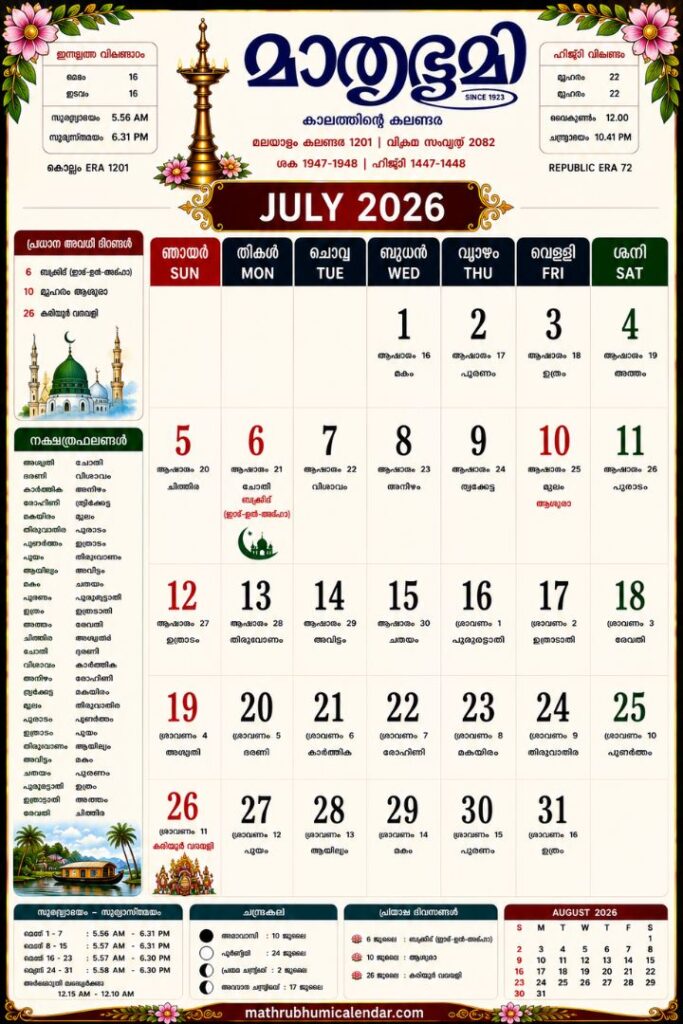
Malayalam Calendar July 2026 Festivals at a Glance
| Date | Day | Occasion |
|---|---|---|
| July 3 | Friday | Sankashti Chaturthi |
| July 10 | Friday | Yogini Ekadashi |
| July 12 | Sunday | Pradosh Vrat & Masik Shivaratri |
| July 14 | Tuesday | Ashadha Amavasya |
| July 16 | Thursday | Jagannath Rath Yatra |
| July 17 | Friday | Karkidakam Sankranti (Karkidakam Begins) |
| July 25 | Saturday | Devshayani Ekadashi & Chaturmas Begins |
| July 26 | Sunday | Pradosh Vrat (Shukla Paksha) |
| July 29 | Wednesday | Guru Purnima (Ashadha Purnima) |
Sankashti Chaturthi, July 3
The month opens with Sankashti Chaturthi, the monthly fast dedicated to Lord Ganesha, observed on the Chaturthi Tithi of the waning moon. Devotees typically keep a day-long fast, breaking it only after sighting the moon in the evening and offering prayers for the removal of obstacles in the year ahead.
Yogini Ekadashi, July 10
Yogini Ekadashi falls in the Krishna Paksha of Ashadha month and is considered especially powerful for overcoming past wrongs and easing health troubles, particularly skin-related ailments. As with other Ekadashi fasts, rice and grains are avoided through the day, and the fast is broken the following afternoon once the Parana window opens.
Pradosh Vrat & Masik Shivaratri, July 12
Two Shiva observances land on the same Sunday this month. Pradosh Vrat, observed on the Trayodashi Tithi, falls in its Ravi (Sunday) form this time and is considered particularly beneficial for good health and longevity. Later the same night, Masik Shivaratri — the monthly observance on Krishna Paksha Chaturdashi — is marked with worship during Nishita Kaal, the auspicious midnight period sacred to Lord Shiva.
Ashadha Amavasya, July 14
This new-moon day of the Ashadha month is traditionally set aside for Pitru Tarpan, holy baths, and charitable giving. Many families use the day to remember departed ancestors, believing that offerings made on Amavasya reach them directly and bring peace to the household.
Jagannath Rath Yatra, July 16
One of India’s grandest festivals, Rath Yatra sees the deities of Lord Jagannath, Lord Balabhadra, and Goddess Subhadra taken out of the Jagannath Temple in Puri and pulled in giant wooden chariots along the Grand Road to the Gundicha Temple. While the main celebration is in Odisha, Rath Yatra processions are also held at temples across Kerala and the rest of India on the same day.
Karkidakam Sankranti, July 17: The Malayalam Month Begins
This is the date that gives the Malayalam Calendar 2026 July its real character. As the Sun transits into Karka Rashi, Karkidakam — the twelfth and last month of the Malayalam calendar — begins, running through to mid-August. Also known as Ramayana Masam, this is Kerala’s most spiritually turned-inward month: continuous recitation of the Adhyatma Ramayanam at home each evening around a traditional Nilavilakku, visits to Vishnu temples for Nalambalam Darshanam, and a general pause on new ventures, house-warmings, and weddings until the month ends. It’s also the traditional season for Karkidaka Chikitsa — Ayurvedic detox treatments — and for drinking Karkidaka Kanji, a medicinal herbal gruel believed to prepare the body for the coming months.
Devshayani Ekadashi & Chaturmas Begins, July 25
Devshayani Ekadashi, falling on the Shukla Paksha Ekadashi of Ashadha, marks the day Lord Vishnu is believed to enter Yoga Nidra, his four-month cosmic sleep, in the Kshirsagar. This also marks the start of Chaturmas, the four-month period traditionally associated with restraint, fasting, and reduced Mangalik activity, which will run until Vishnu is believed to wake on Prabodhini Ekadashi in November.
Pradosh Vrat (Shukla Paksha), July 26
The month’s second Pradosh Vrat also falls on a Sunday, making it another Ravi Pradosh. Devotees observe a day-long fast and offer prayers to Lord Shiva during Pradosh Kaal, the twilight window just before sunset, seeking the same blessings of health and long life associated with this fortnightly observance.
Guru Purnima, July 29: Ashadha Purnima
The full moon of Ashadha month is celebrated across India as Guru Purnima, also known as Vyasa Purnima, honouring Maharishi Veda Vyasa, who is credited with compiling the Vedas and composing the Mahabharata. It’s a day for expressing gratitude to teachers and spiritual guides through prayer, quiet reflection, and acts of service — and it lands just days after Karkidakam has begun, adding a note of scholarly reverence to an already contemplative month.
Why Karkidakam Deserves Its Own Attention
Most Malayalam calendars built around North Indian Panchang templates give Karkidakam a single line, but for Kerala households it’s genuinely the month that defines the whole year’s rhythm. Unlike months built around celebration, Karkidakam is built around restraint — historically the leanest month of the agricultural year, when the monsoon was at its heaviest and families stayed indoors. That inward turn is why Ramayana recitation, Ayurvedic cleansing, and ancestor worship (Karkidaka Vavu, observed later on August 12) all cluster into this single month rather than being spread across the year. If you’re following the Malayalam Calendar 2026 July specifically to plan a wedding, Griha Pravesh, or any Mangalik function, this is the one stretch worth avoiding altogether — most families wait until Chingam, the Malayalam New Year month, begins in mid-August.
Reading the Calendar Beyond Festival Names
A Malayalam Panchang is consulted for more than festival dates — it’s also checked before starting a business, buying property, or beginning a journey, and each day carries its own Nakshatra and Rahu Kalam alongside the Tithi. These daily details are usually printed separately from the main festival table, so if you’re planning something specific, it’s worth checking the Nakshatra and Rahu Kalam columns for your own city rather than relying on a generic all-India timing.
A Few Notes on This Month’s Fasts
- Yogini and Devshayani Ekadashi: Rice and grains are avoided through the day, with the fast broken the following day once the Parana window opens.
- Pradosh Vrat and Masik Shivaratri: A day-long fast, with worship concentrated in the evening or midnight hours rather than at any single fixed time.
- Karkidaka Vavu Bali (observed August 12, just after this month closes): Families planning to travel for ancestor rituals often start preparations while still in Karkidakam.
Anyone elderly, pregnant, or managing a health condition should adapt any of these fasts sensibly — a fruit-based or partial fast is widely accepted across tradition, and checking with a doctor first is always the safer route before a demanding vrat.
Why the Malayalam Calendar Still Matters
Long before printed calendars became common, Kerala households tracked Karkidakam, Chingam, and the rest of the Malayalam months by watching the sky and the monsoon itself — the Kollavarsham system this calendar still follows today runs into its 1201st year in 2026. That continuity is exactly why families still pull out a fresh Malayalam calendar every month rather than relying on memory: it tells you not just what day it is, but which part of the year’s larger rhythm you’re standing in. Priests use it to fix wedding dates once Karkidakam ends, families use it to plan Ekadashi and Pradosh fasts, and in a month that opens with ordinary observances and closes with the start of Ramayana Masam, that context is what makes the calendar worth checking rather than just the date.
It’s also worth knowing that different calendar publishers can occasionally list a Sankranti or Tithi a day apart, almost always due to small differences in local sunrise timing. This is a normal regional variation, not an error on anyone’s part.
Malayalam Calendar 2026 July at a Glance
- Sankashti Chaturthi: July 3
- Yogini Ekadashi: July 10
- Pradosh Vrat & Masik Shivaratri: July 12
- Ashadha Amavasya: July 14
- Jagannath Rath Yatra: July 16
- Karkidakam Sankranti (Karkidakam Begins): July 17
- Devshayani Ekadashi & Chaturmas Begins: July 25
- Pradosh Vrat (Shukla Paksha): July 26
- Guru Purnima (Ashadha Purnima): July 29
Frequently Asked Questions
When does Karkidakam begin in 2026? Karkidakam begins on Friday, July 17, 2026, as the Sun enters Karka Rashi, and runs through to mid-August.
When is Guru Purnima in July 2026? Guru Purnima falls on Wednesday, July 29, 2026, the full moon day of the Ashadha month.
How many Ekadashi fasts fall in July 2026? Two — Yogini Ekadashi on July 10 and Devshayani Ekadashi on July 25, which also marks the start of Chaturmas.
Is Karkidakam a good month for weddings? No. Karkidakam is traditionally considered inauspicious for weddings, house-warmings, and other Mangalik ceremonies. Most families wait for Chingam, the Malayalam New Year month, which follows in mid-August.
When is Jagannath Rath Yatra in 2026? Rath Yatra falls on Thursday, July 16, 2026, when the deities are taken from the Jagannath Temple to the Gundicha Temple in Puri.
Can I download the Malayalam Calendar 2026 July PDF for free? Yes. The PDF carries the same festival, Ekadashi, and Sankranti dates covered in this article and is free to download with no login required.
Conclusion
The Malayalam Calendar 2026 July moves through two distinct moods in a single month — an ordinary run of Ekadashi and Pradosh fasts through the first half, followed by the deep quiet of Karkidakam from July 17 onward. Guru Purnima on July 29 closes the month on a note of gratitude and reflection, fittingly timed just after Ramayana Masam begins. Whatever you’re tracking this month — a fast, a festival, or simply the shift into Karkidakam — this calendar lays out exactly when to mark it.