Walk into almost any Malayali home, whether in Thrissur or Toronto, and you’ll find the Malayalam Calendar hanging somewhere central — not as decoration, but as a working document families actually consult. Known formally as the Kollavarsham, this solar calendar tells a household when to rise before dawn for Vishukani, when the rains of Edavapathi will arrive, and which Saturdays are set aside for a wedding. This guide walks through everything the Malayalam Calendar 2026 covers: the twelve months, the year’s major festivals, and the Vivah Muhurat season.
Unlike the Gregorian year, the Malayalam year doesn’t begin on January 1. It runs on the Sun’s movement through the zodiac, with each of the twelve Masam (months) beginning at a Sankranti — the moment the sun enters a new sign. Tithi-based observances like Ekadashi and Amavasya are layered on top of this solar structure, which is why a Malayalam calendar carries both a fixed solar date for something like Onam and a shifting lunar date for something like Ekadashi in the same printed page.
How to Download the Malayalam Calendar 2026 PDF (Free)
If you’d rather keep this year’s calendar saved on your phone than check a page every time you need a date, you can download it as a PDF in a few steps: look for the download link on this page, usually placed below the festival table; tap “Download PDF” and let it open in a new tab; save it to your device (the share icon on mobile, or Ctrl+S/Cmd+S on desktop); and print a copy for your puja room if you’d like a physical reference. The download is free, with no login required.
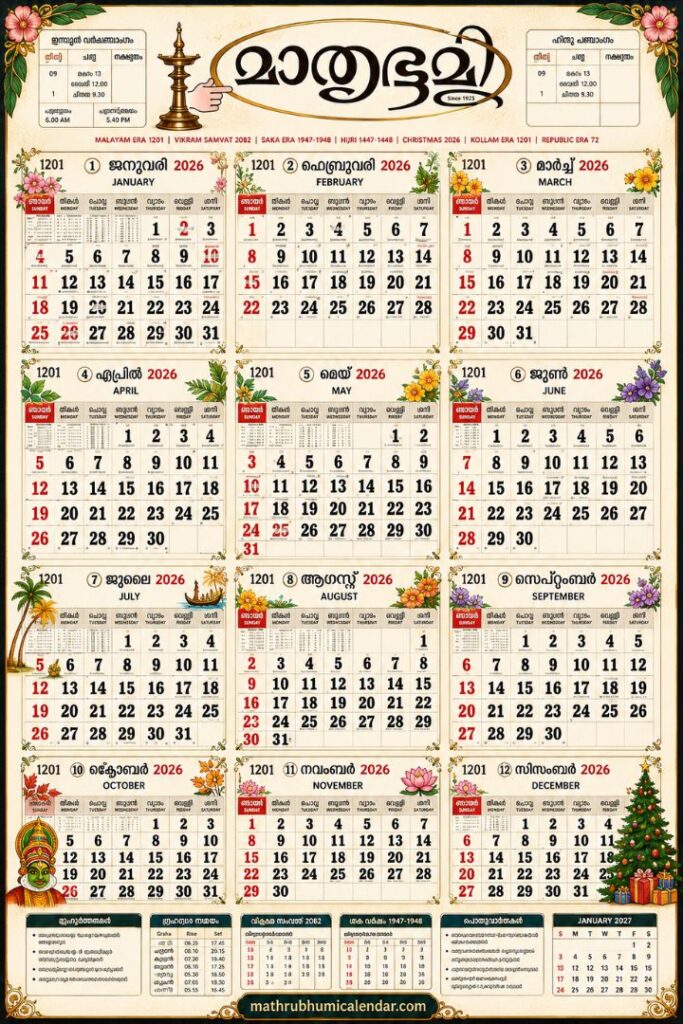
The Twelve Malayalam Months
Each Masam carries its own weather, its own dominant festival, and its own agricultural rhythm.
| Malayalam Month | Approx. Gregorian Period | Defining Character |
|---|---|---|
| Chingam | Aug–Sep | Malayalam New Year; Onam harvest season |
| Kanni | Sep–Oct | Navratri season begins |
| Thulam | Oct–Nov | Thulavarsham — Northeast Monsoon |
| Vrischikam | Nov–Dec | Sabarimala’s Mandala season opens |
| Dhanu | Dec–Jan | Peak Sabarimala pilgrimage |
| Makaram | Jan–Feb | Makara Sankranti and Makaravilakku |
| Kumbham | Feb–Mar | Maha Shivaratri and temple Utsavams |
| Meenam | Mar–Apr | Temple festival season |
| Medam | Apr–May | Vishu — the solar new year |
| Edavam | May–Jun | Southwest Monsoon arrives |
| Mithunam | Jun–Jul | Monsoon deepens |
| Karkidakam | Jul–Aug | Ramayana Masam and Ayurvedic rejuvenation |
Chingam 1, the first day of the Malayalam year, falls on August 17, 2026, carrying the Kollavarsham era forward from 1201 into 1202.
Major Festivals and Public Holidays in 2026
| Date | Festival / Observance | Significance |
|---|---|---|
| Jan 26 | Republic Day | National holiday |
| Feb 15 | Maha Shivaratri | All-night vigil at Shiva temples |
| Apr 14–15 | Vishu | Solar New Year; the Sankranti falls late on the 14th, so Kerala’s main observance lands on the 15th |
| May 1 | May Day | Workers’ Day |
| Aug 15 | Independence Day | National holiday |
| Aug 17 | Chingam 1 | Malayalam New Year begins |
| Aug 26 | Thiruvonam | The main day of Onam |
| Aug 28 | Raksha Bandhan | Coincides with the close of Onam this year |
| Oct 2 | Gandhi Jayanthi | National holiday |
| Nov 20 | Devutthana Ekadashi | Chaturmas ends; wedding season resumes |
| Dec 25 | Christmas | Widely celebrated across Kerala’s Christian community |
Vishu 2026: The Dawn of a New Year, Seen Through Golden Eyes
Vishu marks the moment the sun enters Aries and the month of Medam begins — a solar event that lands on April 14 or 15 depending on how a particular calendar treats the exact Sankranti moment, with most Kerala households centring their observance on April 15, 2026. Unlike Onam’s public spectacle, Vishu is intimate, unfolding in the lamp-lit interior of each home before sunrise.
The ritual at its heart is Vishukani: the night before, the eldest woman of the house arranges a brass Uruli filled with Kani Konna blossoms, raw rice, ripe fruit, gold coins, a lit Nilavilakku, a mirror, and an image of Lord Vishnu. Every family member is led to it blindfolded, opening their eyes to this arrangement as their very first sight of the year — believed to set the tone for the twelve months ahead. Afterward, elders distribute Kaineetam (gift money) to children, everyone wears new Vishuppudam clothes, and the day closes with firecrackers and a bowl of Vishu Kanji.
Karkidakam: Kerala’s Month of Rain, Ramayana and Renewal
Karkidakam, the last month of the Malayalam year, falls across July–August 2026 and is treated less as weather and more as a spiritual season. Every evening through the month, families gather to read aloud from Thunchaththu Ezhuthachan’s Adhyatma Ramayanam Kilippattu, a tradition of household devotion that has anchored Kerala’s literary life for over five centuries. Ayurvedic practice also singles out Karkidakam as the best month for Panchakarma, the theory being that monsoon humidity leaves the body more receptive to herbal oils and therapy.
Onam 2026: A King Returns, a Kingdom Rejoices
Onam is Kerala’s defining festival, observed by Malayalis of every religion, and in 2026 it unfolds entirely within the opening weeks of Chingam. The ten-day countdown begins with Atham on August 17 — the same day as Chingam 1 this year — and builds through First Onam (Uthradam) on August 25, the grand Thiruvonam on August 26, Third Onam (Avittam) on August 27, and finally Fourth Onam (Chathayam) on August 28, which also happens to fall on Raksha Bandhan this year.
At the centre of it all is the story of Mahabali, the Asura king whose reign was remembered as a golden age of equality and plenty. Banished to the netherworld by Vishnu’s Vamana avatar, he was granted one wish: to return each year and see his people happy. Onam is that homecoming, expressed through four traditions — the daily Pookalam flower carpet that grows more elaborate each day; the Onasadya, a 26-dish feast served in a fixed order on a banana leaf; the Vallamkali snake boat races at Aranmula and Alappuzha; and Thrissur’s Pulikali, where performers painted as tigers parade through the streets.
Chaturmas and the Vivah Muhurat Season
Every year, the wedding calendar goes quiet for a stretch, and 2026 follows the same pattern. Chaturmas — the four-month period when Lord Vishnu is believed to rest in Yoga Nidra — begins with Devshayani Ekadashi on July 25, 2026, and continues until Devutthana Ekadashi on November 20, 2026. Weddings, engagements, and Griha Pravesh ceremonies are traditionally paused for the entire stretch, which is why the Vivah Muhurat calendar shows nothing at all for August, September, and October this year. February and June carry the most auspicious windows earlier in the year, while wedding season resumes in earnest from November 19–20 onward, once Devutthana Ekadashi has passed. For couples planning a date, checking a full month-by-month Muhurat list against your Kundli with a family astrologer is the recommended next step.
Sabarimala Mandala Season
Vrischikam Masam, falling across November and December, opens Sabarimala’s Mandala season — one of the largest annual pilgrimage gatherings anywhere, drawing devotees who undertake a period of strict vegetarian diet, celibacy, and daily prayer before the trek to Lord Ayyappa’s forest shrine. The season continues into Makaram, closing with the Makaravilakku sighting in mid-January.
Njattuvela: Kerala’s Agricultural Almanac
The feature that sets the Malayalam calendar apart from any other Indian almanac is Njattuvela — a system tracking the sun’s roughly 13–14 day transit through each of the 27 Nakshatras to predict rainfall intensity and planting windows. This isn’t folk superstition; it’s an observational system refined over centuries specifically for Kerala’s geography, and it remains genuinely useful to farmers deciding when to sow paddy or when to hold off because a drought-prone Njattuvela period is approaching. Printed editions like the Mathrubhumi Calendar list the exact start and end date of every Njattuvela period each year.
Malayalam Calendar vs Hindu Panchang: What’s Different
The core difference is structural. The Malayalam calendar is fundamentally solar — each month begins at a fixed Sankranti, so Onam always falls in Chingam and Vishu always opens Medam. Most of the North Indian Hindu calendar, by contrast, is lunisolar, which is why Diwali shifts between October and November each year depending on the moon. Malayalam calendars still layer lunar Tithi calculations on top of the solar month structure for observances like Ekadashi and Amavasya, which is why a printed Malayalam calendar carries both systems side by side rather than replacing one with the other.
Frequently Asked Questions
When does the Malayalam New Year begin in 2026? Chingam 1 falls on August 17, 2026, marking the start of Kollavarsham year 1202.
When is Vishu in 2026? The Sankranti moment falls late on April 14, with most Kerala households observing Vishukani on the morning of April 15, 2026.
When is Onam 2026? The ten-day celebration runs from Atham on August 17 to Chathayam on August 28, with Thiruvonam, the main day, falling on August 26.
Why are there no wedding dates from August to October 2026? This falls within Chaturmas, which runs from Devshayani Ekadashi on July 25 to Devutthana Ekadashi on November 20, 2026.
What makes the Malayalam calendar different from other Hindu calendars? It is a solar calendar with fixed month boundaries at each Sankranti, while most Hindu Panchangs elsewhere in India are lunisolar, so festival dates like Diwali shift year to year in a way Onam and Vishu don’t.
Can I download the Malayalam Calendar 2026 PDF for free? Yes, the PDF version covering the same festival dates in this article is available to download free of charge, with no login required.
Conclusion
The Malayalam Calendar 2026 carries a Malayali household through a genuinely full year — Vishu’s quiet dawn ritual in April, the monsoon devotion of Karkidakam’s Ramayana Masam in high summer, the ten-day joy of Onam at the start of Chingam, Chaturmas pausing weddings from late July to November, and Sabarimala’s Mandala season closing out the year. Whether you’re tracking it for religious observance, wedding planning, or simply to know when the rains are due, this guide gives you the full shape of the year in one place.