February 2026 carries Kerala and the wider Malayalam-speaking community through the tail end of Makaram month into the start of Kumbham, bringing with it Thai Pooyam, Maha Shivaratri, and a cluster of Ekadashi fasts along the way. This guide lays out the complete Malayalam Calendar 2026 February with verified dates for every major festival, Vrat, and observance, so you can plan pujas, temple visits, and family celebrations for the month with confidence.
Because festival dates published online for the same month can vary quite a bit between sources — sometimes by several days — every date below has been cross-checked against multiple current Panchang references rather than taken from a single listing, so you can rely on it as an accurate starting point.
How to Download the Malayalam Calendar 2026 February PDF (Free)
If you’d like to keep this month’s calendar on hand without checking a webpage each time, you can save the Malayalam Calendar 2026 February as a PDF in a few simple steps. The PDF carries the same festival dates and Vrat details covered in this article, arranged in a clean, printable layout.
- Look for the download link on this page — usually placed just below the festival table or at the end of the article.
- Tap or click “Download PDF.” The file opens in a new browser tab.
- Save it to your device. On mobile, use the share or download icon in your PDF viewer; on desktop, press Ctrl+S (or Cmd+S on Mac) to save it to your downloads folder.
- Print a copy if you’d like it on your puja room wall or kitchen noticeboard for quick reference through the month.
- Check back at the start of each month, since a fresh PDF is typically published for every new month’s calendar.
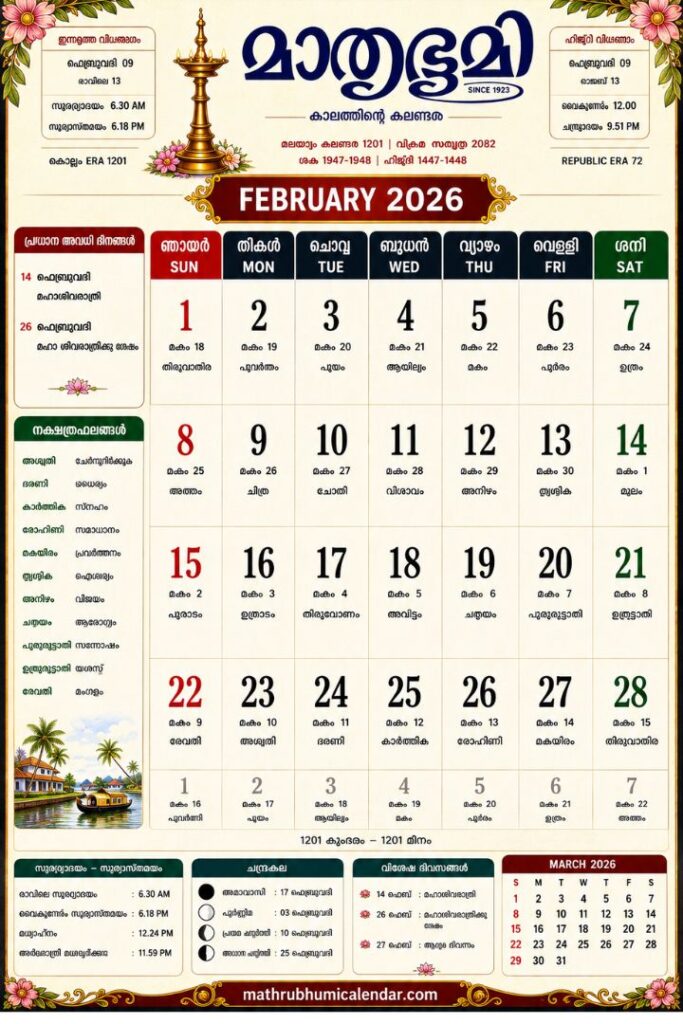
Understanding the Malayalam Calendar
Before diving into the festival list, it helps to understand what makes the Malayalam Calendar distinct. Known as the Kollavarsham or Malayalam Era, it is a solar calendar believed to have begun around 825 CE, and it runs on its own set of twelve months — Chingam, Kanni, Thulam, Vrischikam, Dhanu, Makaram, Kumbham, Meenam, Medam, Edavam, Midhunam, and Karkidakam — each tied to the sun’s movement through the zodiac rather than the moon’s phases. This is different from the lunar Panchangs, like the Thakur Prasad or Lala Ramswaroop calendars followed in North India, which name festivals by Tithi (lunar day) within a lunar month.
In practice, most Hindu festivals observed in Kerala — Ekadashi fasts, Shivaratri, Amavasya rituals — still follow the same lunar Tithi system used across India, since these are Pan-Indian observances tied to the moon. What changes regionally is the solar month name used for local Kerala-specific festivals, seasonal references, and temple almanac dates. February 2026 sits at the boundary between two Malayalam months: it opens in the final weeks of Makaram and moves into Kumbham once the sun enters Aquarius around February 13, which is also marked separately in the Panchang as Kumbha Sankranti.
Major Festivals and Observances in February 2026
| Date | Day | Festival / Event | Significance |
|---|---|---|---|
| Feb 1, 2026 | Sunday | Thai Pooyam (Thaipusam); Magha Purnima; Guru Ravidas Jayanti | Lord Murugan’s Vel Kavadi festival, observed with Kavadi Aattam at major temples; also the Magh full moon and Guru Ravidas’s birth anniversary |
| Feb 4, 2026 | Wednesday | World Cancer Day | An international awareness day, not a religious observance |
| Feb 5, 2026 | Thursday | Sankashti Chaturthi (Dwijapriya) | Monthly fast for Lord Ganesha, observed after moonrise |
| Feb 13, 2026 | Friday | Kumbha Sankranti; Vijaya Ekadashi | The Sun’s entry into Aquarius, marking the start of Kumbham month; also an Ekadashi fast dedicated to Lord Vishnu |
| Feb 15, 2026 | Sunday | Maha Shivaratri | The Great Night of Shiva, marked with a night-long vigil, fasting, and Jalabhishek |
| Feb 17, 2026 | Tuesday | Phalguna Amavasya | A new moon associated with ancestor worship, Tarpan, and charity; an annular solar eclipse also occurs this day, though it is not visible from India |
| Feb 19, 2026 | Thursday | Shivaji Jayanti | Birth anniversary of Chhatrapati Shivaji Maharaj, widely observed in Maharashtra |
| Feb 27, 2026 | Friday | Amalaki Ekadashi | Also called Rangbhari Ekadashi; dedicated to Lord Vishnu and the sacred Amla tree, falling shortly before Holi |
Thai Pooyam: The Month’s Biggest Temple Festival
Thai Pooyam falls on Sunday, February 1, 2026, and is arguably the most visually striking festival on this month’s calendar for devotees of Lord Murugan (Subrahmanya). The day commemorates Goddess Parvati presenting the divine Vel (spear) to Murugan so he could defeat the demon Surapadman, and it is marked by Kavadi Aattam — devotees carrying decorated wooden or metal structures, sometimes attached with hooks or skewers as an act of penance, in procession to Murugan temples. In Kerala, notable celebrations take place at temples in Palani-linked traditions and various Subrahmanya shrines, while the festival reaches its largest scale at Batu Caves in Malaysia and major Murugan temples across Tamil Nadu.
By coincidence, this year Thai Pooyam falls on the exact same date as Magha Purnima, the full moon of the Magh month, and Guru Ravidas Jayanti, the birth anniversary of the 15th-century Bhakti saint Sant Ravidas — making February 1 an unusually full day of devotion across different traditions.
Maha Shivaratri 2026: Date and Observance
Maha Shivaratri falls on Sunday, February 15, 2026, observed on the Krishna Chaturdashi Tithi of the Magha-Phalguna transition. As the “Great Night of Shiva,” the day commemorates the divine union of Shiva and Parvati and is marked by a night-long vigil (Jagarana), fasting, and Jalabhishek — the ritual pouring of water, milk, or Gangajal over the Shivling — performed across all four Prahars (watches) of the night. Temples across Kerala hold special abhishekams and extended darshan hours through the night, and many devotees observe a fast that is broken only the following morning after the Chaturdashi Tithi ends.
Kumbha Sankranti and Vijaya Ekadashi: A Shared Day
February 13, 2026 (Friday) brings two significant observances together. Kumbha Sankranti marks the Sun’s transition from Capricorn into Aquarius (Kumbha Rashi), the moment that also opens the Malayalam month of Kumbham. This solar transition is considered auspicious for holy river baths, Surya worship, and charity. On the very same day, Vijaya Ekadashi, a Krishna Paksha Ekadashi of the Phalguna month, is observed for spiritual victory over obstacles — its Vrat Katha recounts Lord Rama fasting on this day before crossing the ocean to Lanka.
Ekadashi Fasting Dates in February 2026
| Date | Day | Ekadashi | Note |
|---|---|---|---|
| Feb 13, 2026 | Friday | Vijaya Ekadashi | Falls in Phalguna Krishna Paksha, coinciding with Kumbha Sankranti; associated with overcoming obstacles |
| Feb 27, 2026 | Friday | Amalaki Ekadashi | Also called Rangbhari Ekadashi; dedicated to Lord Vishnu and the Amla tree; fast is broken (Parana) the following morning, Saturday, February 28 |
It’s worth noting that Jaya Ekadashi, sometimes listed on generic calendars as a February observance, actually falls earlier in the year — on January 29, 2026 — and does not repeat in February. If you’ve seen it listed for this month elsewhere, that’s a common date mix-up worth double-checking against a current Panchang.
Phalguna Amavasya and the February Solar Eclipse
Phalguna Amavasya falls on Tuesday, February 17, 2026, a new moon widely observed for Pitru Tarpan (offerings to ancestors), Shraddha rituals, and charity. This year carries an additional astronomical event: an annular solar eclipse coincides with this Amavasya, though it will not be visible from India, so Sutak-related restrictions tied to eclipse viewing do not apply locally. The day remains significant primarily for its role in ancestral remembrance rather than for the eclipse itself.
Why Accurate Dates Matter for Malayalam Calendar Readers
Kerala’s Hindu community follows festival dates that blend the solar Malayalam month system with the same lunar Tithi calculations used across India, and Panchang publishers can differ on exact dates due to how they calculate Udaya Tithi (the Tithi prevailing at sunrise), regional sunrise times, and Purnimant versus Amant lunar month conventions. This is exactly why two calendars for the “same” month sometimes list a festival a day or even a week apart — a discrepancy that’s common enough that it’s worth cross-checking any date that affects an actual ceremony against your family temple’s own Panchangam rather than relying on a single online source.
Tips for Observing February’s Fasts
- Sankashti Chaturthi: A single-meal or grain-free fast is common, broken only after moonrise in the evening.
- Vijaya Ekadashi and Amalaki Ekadashi: Grains, rice, and pulses are typically avoided; the fast is broken the following morning after sunrise, within the Dwadashi Tithi.
- Maha Shivaratri: Many devotees keep a Nirjala (waterless) fast through the night vigil, though partial or fruit-based fasting is a widely accepted alternative for those with health concerns.
- Phalguna Amavasya: Best marked with an early holy bath, Tarpan for ancestors, and charity rather than a strict fast.
As always, health comes first. Anyone with a medical condition, who is pregnant, or elderly should adapt a fast sensibly and consult a doctor if a full Vrat isn’t advisable — most Hindu fasting traditions already allow for partial or fruit-based alternatives for exactly this reason.
February 2026 at a Glance
- Thai Pooyam, Magha Purnima & Guru Ravidas Jayanti: February 1
- World Cancer Day: February 4
- Sankashti Chaturthi: February 5
- Kumbha Sankranti & Vijaya Ekadashi (Kumbham month begins): February 13
- Maha Shivaratri: February 15
- Phalguna Amavasya (with annular solar eclipse, not visible in India): February 17
- Shivaji Jayanti: February 19
- Amalaki Ekadashi: February 27 (Parana on February 28)
Frequently Asked Questions
When is Thai Pooyam in 2026? Thai Pooyam falls on Sunday, February 1, 2026, the same date as Magha Purnima.
When is Maha Shivaratri in 2026? Maha Shivaratri falls on Sunday, February 15, 2026, with the main night vigil running into the early hours of February 16.
When does the Malayalam month of Kumbham begin in 2026? Kumbham begins around February 13, 2026, when the Sun transitions into Aquarius at Kumbha Sankranti.
How many Ekadashi fasts fall in February 2026? Two — Vijaya Ekadashi on February 13 and Amalaki Ekadashi on February 27.
Is Jaya Ekadashi observed in February 2026? No. Jaya Ekadashi falls earlier, on January 29, 2026, and is sometimes incorrectly listed as a February date on generic calendars.
When is the next Amavasya after Maha Shivaratri in 2026? Phalguna Amavasya falls two days later, on Tuesday, February 17, 2026.
Is there a solar eclipse in February 2026? Yes, an annular solar eclipse coincides with Phalguna Amavasya on February 17, 2026, but it will not be visible from India.
Can I download the Malayalam Calendar 2026 February PDF for free? Yes. The PDF version, with the same festival and Vrat dates covered in this article, is available to download free of charge from the link on this page, with no login required.
Conclusion
February 2026 moves the Malayalam Calendar from the closing days of Makaram into the start of Kumbham, opening with the devotional spectacle of Thai Pooyam, building through Maha Shivaratri’s night of Shiva worship, and closing with Amalaki Ekadashi just ahead of Holi season. With two Ekadashi fasts, a major Sankranti, and a solar eclipse-linked Amavasya all packed into four weeks, this guide gives Malayalam Calendar readers a complete, verified reference to plan the month’s pujas and observances around.